 A HISTORY OF SIVOGAH TO DRAPER CITY 1849—1977
Volume Two of History of Draper, Utah
(From Draper Historical Society website)
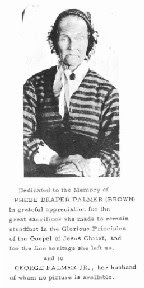
This article mentions Zemira Palmer's uncle Zemira Draper (Phebe's brother) and Zemira's stepfather, Ebenzer Brown. Pictured are Ebenezer Brown and Phebe.
PROLOGUE
Sivogah, meaning Willows, the Indian name for the area later known as Draper, is a beautiful cove of approximately fifteen square miles tucked away in the southeast corner of Great Salt Lake Valley. Draper, nestled west of towering Lone Peak, receives water from glaciated and stream-cut canyons beginning at 12,000 feet and sweeping down to a valley floor of 4,400 feet.
On the southern edge of this fertile cove are the Traverse Mountains, low hills branching west from the mighty Wasatch Range and continuing west for three miles to end suddenly in a dramatic drop to benches formed by ancient Lake Bonneville. The highest and most famous of these drops, Steep Mountain, has been a mecca for gliders towed into the air by motorized vehicles to catch updrafts and climb hundreds of feet into the clear, blue sky. A part of Steep Mountain called Widow Maker became nationally known for motorcycle hill-climbing contests. Motorcyclists, congregated for competition, were trying to be first to reach the top of the mountain. Hang gliders came later to take pilots soaring off Steep Mountain; both the less daring glider and hang-glider pilots had a bird’s-eye view of little-known Hidden Valley, and the well-known Jordan River to the west. All of these events were popular during the 1960s through the 1980s. Some hang-glider pilots continue to soar off Steep Mountain.
A mountain of sand, a gift of ancient Lake Bonneville, creates the southwestern boundary of the cove, known as Point of the Mountain. In bygone years, train cars of sand in the thousands were loaded by steam shovels, cutting back into the mountain and destroying the ribbon-like Indian trails that traversed this area long ago. Currently, semi-trucks, filled to capacity by diesel loaders, move sand from these benches for use locally and nationwide in building roads, houses, skyscraper buildings, and hundreds of other projects requiring sand. Moving millions of yards of sand over many years has allowed the I-15 freeway to be widened into a six-lane highway, with frontage roads on each side and a railroad track along its east side. Very few drivers know of the space between mountain benches and the one-hundred foot cliff-like drop into Hidden Valley below.
The only human inhabitants for centuries consisted of migratory Indian tribes who pitched their tepees by mountain streams and along the Jordan River. Fishing the river, Indians could begin at Utah Lake and fish north to Great Salt Lake, a distance of thirty-one miles. The large area between the lakes has often been compared to the Sea of Galilee, the River Jordan, and the Dead Sea area in the land of Israel.
In 1776, Fathers Escalante and Domingues, with their flowing robes and supply-laden mule trains, explored the Utah Valley, stood on Point of the Mountain, viewed Great Salt Lake, and then turned south. This was the same year representatives of the thirteen American colonies signed the Declaration of Independence.
Mountain men, wearing buckskin clothing and using flintlock rifles and powder horns, occasionally traversed the cove, making no records and leaving no traces. Trappers too, in search of beaver dams and small animal habitats, set their traps, collected their pelts, and left. Neither was looking for a place to settle and both failed to recognize the potential of the great grasslands and plentiful streams that later enticed Mormon pioneers hungry for a home and for land they could call their own.
FIRST PIONEERS TO SEE THE SOUTH WILLOW CREEK AREA
"The first man to enter Draper was Joshua Terry. He and his companion, Levi Savage, made their camp in South Willow Creek in the year of 1847. Joshua Terry was born in Albion, Canada, on August 11, 1825. He joined the Mormon Church on June 20, 1840. Before making camp in Draper, Joshua Terry and Levi Savage worked in the canyons and neighboring fields around South Willow Creek." These pioneers did not visit South Willow Creek as settlers but were only passing through.
A majority of the pioneers came from Europe, England, Canada, isles of the sea, and other beautiful parts of the world, leaving comfortable homes, traveling by sailing ship, ox-drawn covered wagon, handcart, on horseback, and many of them walking, being led by a modern-day prophet. They gathered in the Utah desert, including South Willow Creek (Draper), hungry, tired, and weary after their arduous journey from their homelands. With faith and fortitude, these sturdy, God-fearing pioneers helped build an empire and made the desert blossom.
The western United States, prior to and including 1847, was Mexican territory, an unsettled vast open area, and for this reason was an area desirable for colonizing by Mormon pioneers. On 24 July 1847, pioneers traveling by wagon train entered the valley of the Great Salt Lake through Emigration Canyon. At last the Mormons could worship without the persecution they had experienced over the last seventeen years. Peace was short-lived, however, for in 1848 the war with Mexico ended and the United States was awarded the Mexican Territory, which comprised most of the western states as now constituted. On 9 September 1850, the Territory of Utah was created by an act of Congress, and persecution began again as United States government officials were appointed to govern settlers of the Utah Territory.
GOVERNMENT
The "provisions of the act of congress of the 24th day of April, 1820, entitled ‘An act making further provisions for the sale of the Public Lands,’" Utah. p. 1 allowed patents to land through certificates of registration in land offices throughout territories of the United States. Homesteads were not created in the cove because the land had not been surveyed. As legal descriptions were generally unavailable, land in South Willow Creek was occupied by squatters. A "squatter is a person who lives on land to which he has no deed or other evidence of title. Usually he may make a valid claim to the land if there is no other person with a legal claim. . . . Congress passed special laws which allowed squatters to [eventually] gain title to lands they occupied."
"[Greater Salt Lake County] was organized with Elias Smith as county and probate judge." This was done because President Brigham Young and the legislature knew there was an urgency in setting up a legal structure that would include courts and land offices where legal land descriptions could be registered. He knew people needed protection from drifters and lawless elements making life difficult in the Valley.
On 6 October 1853 the people of South Willow Creek, applying for a post office, registered their settlement as Brownsville in honor of Ebenezer Brown, the first settler, only to be rejected. Another Brownsville, which later became Ogden, had already been registered in the territory. South Willow Creek was renamed Draperville in honor of William Draper Jr., the first presiding elder in Draper. Ebenezer Brown, although illiterate, was appointed the first postmaster in1854. His wife Phoebe did all the postal work in an office located in their home in the Draperville fort. Draper Historical Society Library. On 14 March 1855, David James was appointed the next postmaster, followed by George Spilsbury on 26 November 1860.Washington D.C., 29 Sept. 1994. DHS Library.
Draper was distinguished for the evolution of its name: Sivogah, Willow Creek, South Willow Creek, Brownsville, Draperville, and finally Draper. In an early journal entry, Andrew Jackson Allen, a pioneer of Draperville, wrote, "Now this country ware set of as a territory and calld Utah and we sent a brother to Washington to represent the people of Utah Territory, but it seemd as tho the saints could not have there just rights and we ware denied in allmost every instence."
Because of the threat of Indian uprisings, Ebenezer Brown donated land in the area of 12650 South and east of 900 East for a fort, with dimensions of 35 rods (577.5 feet) north to south and 23 rods (379.5 feet) east to west. The fort walls of adobe bricks were started in 1853, then during 1857 when Johnston's Army was a threat, the pioneers began to widen the wall and extend its height to nine feet. The threats ended before construction was completed, so the fort was never finished or enclosed. Remains of the walls are nonexistent, but the general location of the fort is well-known since the Draper Historical Park is being developed on part of the fort site at this time (1999).
Additional information regarding the Draper Fort is recorded in Perry Fitzgerald’s history: "The Indians were quite numerous in the area and causing some trouble, so, in 1854, the settlers decided to build a fort for their protection. It was big enough to house 31 families and some of the people lived there, especially during several winters. . . .
". . . Perry rendered valuable service in defending the colonists during Indian difficulties, and he showed courage in the fight with the Indians at Battle Creek (now known as Pleasant Grove). During the Walker War he was active in every measure which was taken for the welfare of the people. He was elected as first lieutenant of the Willow Creek Militia, Company A."
Many Draperville residents were included among 3,000 Saints celebrating the tenth anniversary of the arrival of the pioneers into the Valley at Silver Lake in Big Cottonwood Canyon with Governor Young.
"On the 24th, the flag was unfurled from the summit of the highest peak. Prayer was offered and the singing and cannon roared. The juvenile rifle corps performed an excellent drill. Brigham Young asked John Bagley to climb to the top of a tall pine tree and top it to mount a flag. So John climbed the tree, cut it off, and stood on his head on the top of the tree to show his courage and agility. In New Brunswick [where John Bagley was from], before a pine tree was cut down, the lumberjacks would top it. It literally meant pining the tree or getting it to a point where they took off the top so they could have the log. Then if you were especially skilled, you would stand on your head on top of the topped tree. So, this is what John Bagley did."
Individual histories see the celebration a little differently, but an official statement by B. H. Roberts has the final say. The official count was "2,587 persons in the company; with 464 carriages and wagons, 1,028 horses and mules, and 332 oxen and cows. . . . [The official news of Johnston’s Army was delivered:]
"‘About noon’ Messrs. Smoot, Stoddard and Rockwell, these men with the ‘war news,’ accompanied by Judge Elias Smith from Salt Lake City, rode in upon this scene of peace and joy and patriotism. Their advent, however, did not disturb the peace and joyousness of the occasion. Their message was delivered quietly to President Young and his immediate counselors and associates. For the rest, the afternoon’s merriment and enjoyment went on as if no messengers from the east had arrived."
When settlers knew Johnston’s Army was coming, pioneers began preparing for their defense under the direction of Governor Brigham Young who met with government officials in hopes to dissuade the army from entering the Valley. When that was not possible, he told them they could enter without their guns. On their refusal, Governor Young informed them the Saints would defend themselves and would not move again. Andrew Jackson Allen recorded in his diary on 11 July 1857, page 5: "Had a company drill at willow creek where I lived for the first time." The Utah Militia was mustered and residents prepared to burn their homes and all their property and move south. Brigham Young made it plain there was not to be left for the enemy one building, one foot of lumber, a tree, or parcel of grass that would burn.
Many Draper men were involved in this new emergency: "[Norman Brown] was a scout for Lot Smith for fifty-two days and was in the Utah Legion."
We find for 15 August 1857, on page 6 of Andrew Jackson Allen’s diary, "There ware ten men cald on from the Willow Creek division."
Who the ten men were is not known. In other entries, A. J. Allen wrote about fifteen and twenty men being called to serve. Complete lists were not recorded; however, the following men were involved in the Utah War in some capacity: Andrew Jackson Allen, William C. Allen, John Bagley, Guernsey Brown, Norman Brown, Charles Burnham, Charles Crapo, Henry Eastman Day, John Enniss, John Fitzgerald, James Green, Frank Johnson, Roan Palmer, Orrin Porter Rockwell, Tom Stokes, Joshua Terry, and possibly a few others.
"Sept 26th [1857] Got orders to start out to meet the soalders as they intend to come in, started the same day went to S.L. City."
The Draperville men answered the call and outfitted themselves for the campaign. They were ready to leave by 23 August 1857, but it was in September that the orders arrived.
From the Andrew Jackson Allen diary for 22 November 1857, page 10, we learn: "Got orders to go on to Weber and recruit here the ground was partly bare of snow, here I fel in with Mager Tilor from home at Willow Creek and Cornal Harmon with there command. There ware 20 of the boys right from willow creek here I got a bundle from home that I kneeded very much." For 24 January 1858, on page 11: "We are making arangements to gow out in the spring to defend our people from our ennemies from the U.S." For 27 January, the diary reads, "As well as those on our boarders, I was selected for one 15 was to gow from Willow Creek where I live."
"Porter Rockwell selected men he wanted to help him with a scouting expedition and chose the men from Willow Creek. Their duty was to spy on the army, get what information they could and stop it if possible. Brigham Young issued orders to the militia not to kill one man, but to destroy all the wagon trains and supplies and to stampede or drive all their animals away. The men knew the Lord would protect them and they carried out the order in full Lot Smith’s company burned 73 wagons of supplies and drove off 150 head of cattle belonging to the army." One Hundredth Anniversary of the Draper War, p.27
"Henry [Eastman Day] was one of the 25 men who marched up to the army and told those in command what they intended to do. They were angrily told that there were not enough of them to do it. Lott Smith told them that all he had to do was whistle if he needed more help, even though his men all knew there were no more men within 40 miles. The soldiers handed over their ‘bill of laden’ and Lott Smith and his men took all the firearms, put the men, about 100, under guard and burned the wagons. Henry said he cut up the yoke the oxen wore for kindling to light the wagons. When peace was negotiated Henry Day returned home."
"About this time Johnston’s Army was going to pass through the Salt Lake Valley, and the settlers were advised to move their livestock a few miles away from their path. So Ezekiel [Price] drove what [livestock] he had to Fort Canyon, a short distance northwest of Alpine. His mother and sister, Ann, also moved to Alpine."
Through the good work and efforts of Colonel Thomas Kane, a long-time friend of the Mormons, who pleaded their case, President Buchanan realized the Mormons were not in rebellion, and peace was finally obtained. On 27 June 1858, Johnston's Army came into Salt Lake City, passed over Jordan, and camped to rest before moving southwest to Camp Floyd. Gentile merchants followed them in with their supplies. President Young counseled the pioneers not to trade with them until there were some arrangements made between the merchants, the army, and the Church. "Brigham told the brethren to be incouriaged that they would gow back to there old homes. To day I am at my oald place on Willow Creek. I can see the soaldiers camp mooving up Jordan."
While Henry E. Day’s family waited anxiously above Alpine for Johnston’s Army to pass through the Salt Lake Valley, Leah Rawlins Day gave birth to her child, Leah Jane Day, in a cave or dugout. During the long wait, two men were left in Draperville to take care of things, irrigate crops, and torch the homes and buildings if necessary. The two men were 17-year-old John Fitzgerald and 36-year-old John Enniss.
Some time following the 24th of July celebration, pioneers began preparing for their immediate defense. Andrew Jackson Allen says, "I mooved my famely to Utah valley and set them down without anny covering only a waggeon cover on a waggeon box." This is probably one of many families who moved over the hill into Mountainville, the area now called Alpine.
"During the Johnston Army troubles he [Joseph S. Rawlins] was captain of the guards sent out to guard the passes in Echo Canyon against the approach of the army; and also participated in fighting many of the Indian uprisings in Utah."
From Andrew Jackson Allen’s diary for 1858, page 14: "July 1st The word came to our camp that we could moove back to our homes. July 2nd Me with many others mooved our affects back."
The Mountainville camp (Alpine) ended short of two months. On 6 July 1858, the army moved to a permanent camp in Cedar Valley at Camp Floyd. Federal troops were retained at this camp until the army "left Camp Floyd for Washington, D.C. [on 1 March 1860]." Then the camp was abandoned, leaving wagons, large guns, and empty buildings.
Having 2,500 military personnel and many services attached to the camp brought worldly problems to the Utah Territory. Orrin Porter Rockwell had a saloon and way station near the Crystal Hot Lakes, just south of where the Utah State Prison now stands. The saloon furnished not only alcohol but food and a rest stop for stagecoaches and the pony express riders. Some of the settlers joined in with the worldly ways and much control of the Utah Territory was lost by the Church authorities. In order to establish law and order in the Draperville area, John Fitzgerald, born on 24 March 1840, "was appointed first justice of the peace."
CHURCH
Ebenezer Brown, as was the custom, received a call from President Brigham Young on 7 December 1850 to go on a settlement mission. By September of 1852 he was back in South Willow Creek for the organization of a branch of The Church of Jesus Christ of Latter-day Saints. William Draper was designated presiding elder, with Ebenezer Brown and Zemira Draper as his counselors. By the spring of 1852, twenty families had settled in Draperville: Andrew Jackson Allen, George Bankhead, Ebenezer Brown, Joseph Guernsey Brown (a step brother to Zemira Palmer. They both helped rescue the Martin and Willie Handcart companies.) Andrew Burnham, Henry Eastman Day, James Downs, William Draper, Zemira Draper, John Enniss, Perry Fitzgerald, Harvey M. Rawlins, Joseph Sharp Rawlins, Robert Shipley, Absalom Wamsley Smith, John Sivil Smith, Jacob Terry, Joel E. Terry, William Reynolds Terry, and John P. Wright.
President Brigham Young, after settling the pioneers in Salt Lake, sent scouts and surveyors to establish settlements throughout the vast Mexican Territory.
Joseph S. Rawlins and his family moved to Draper in 1850. "For twenty years thereafter they made their home at Draper, nine miles south of Murray. During this time our subject crossed the plains seven times, bringing three companies of immigrants to Utah, and also served for three months as guard in protecting the United States overland mails, serving under Captain L. Smith with the rank of lieutenant."
Ester Ann Munro was married to John Boulter on 29 January 1855 by the first elder of Draper, William Draper, Ester’s great-uncle. She and John moved to Spanish Fork where they had three children. They then moved back to Draper, after which she did community work and practical nursing. Many people called her Aunt Ester. To this union were born twelve children, six of whom lived to adulthood.
When William Draper (another of Phebe's brothers), first presiding elder of Draper, moved to Sanpete County, the Draperville Branch was organized into a ward in October 1856 and remained part of the Salt Lake Stake, replacing the branch created three years earlier. Isaac Mitton Stewart was sustained as the first bishop, William Reynolds Terry, the first counselor, Absalom Wamsley Smith, the second counselor, and John Heward, the clerk. The bishopric served without pay under the governing body of The Church of Jesus Christ of Latter-day Saints, the First Presidency and the Quorum of the Twelve Apostles.
Two local priesthood holders visited the homes of pioneers each month, noting conditions of health, shelter, and provisions of food and clothing, which they later reported to the bishop and his two counselors, who administered both the spiritual and temporal affairs of the settlement. Nearly every family owned copies of the scriptures used in Church meetings. Passages from these scriptures were read and explained as family members took turns reading. Following the spiritual message, pioneering and Indian stories were shared, home-building and farming practices discussed. Exchanging experiences provided parents and children the opportunity to improve their storytelling techniques. These visits were usually completed with all kneeling in family prayer.
Sunday School in the Church was organized two years after the Saints entered the Great Salt Lake Valley. On 17 May 1857 a Sunday School was first commenced in Draperville, it being one of the first Sunday Schools ever organized in Utah. Ann Wilson Fitzgerald, with Elizabeth Heward and Elisabeth Enniss, began that organization in Draperville and taught the youngsters who came each Sunday.
Men were sent from Church headquarters in Salt Lake occasionally to encourage pioneers to be faithful in living the commandments. "Too of the brethren who were sent out to visit the settlements and preach calld at our place thay held three meetings.
"Those meetings ware verry interesting there was a good spirit prevaild many of the brethren expresst there fellings felt that the lord had been with the saints in there present difficulty with the Jentiles as we had not one man fallen in all the difficulty."
Life had become more manageable toward the end of this decade, and the pioneers felt blessed that their hardships were lessening. Many thought being rebaptized would show their gratitude for surviving and overcoming the hardships encountered crossing the plains and becoming established in prospering settlements. Others were rebaptized as they attempted to live the United Order. Even President Brigham Young was rebaptized. Andrew J. Allen recorded in his diary for 27 May 1860, on page 18, "I baptised Purlina and Sary Martha [his daughters] for remission of sins and Purlina for hir helth."
"[Norman Brown] was the sexton of the Draper [Ward] Cemetery until a few years before his death, having dug nearly all the graves in that cemetery until that time, most of them without remuneration."
"William [Reynolds Terry] received a very important letter [about 1859]. It was written by President Brigham Young, asking William to come to his Salt Lake office. Early the next morning William hitched two horses to a wagon and journeyed to town. The president was busy meeting other people, so William waited his turn. An office boy called those waiting, and thus it went all day without William being called. When evening came he journeyed home to his family. Soon after, he received a second letter from President Young inquiring why he had not come in. William sat down and wrote the following words back to the President: ‘I received your first call to come to your office and drove in to see you the next morning. And waited all day, but it seems your help was unable to see me. So if you care to see me about anything I am still living in Draper and it is the same distance from Salt Lake to Draper as it is from Draper to Salt Lake.’
"Within the next few days Brigham Young paid him a visit. The President called William to settle in St. George. No doubt the family hated to leave their lovely home and all their friends, but they obeyed the call from the Lord’s anointed and moved to St. George."